Need a virtual analogue synth with a classic layout that doesn’t hide parameters in menus? Looking for a professional-grade instrument that won’t cost you anything? The Tyrell Nexus free download delivers exactly that—a straightforward, two-oscillator synthesizer built for fast sound design and distributed as freeware.
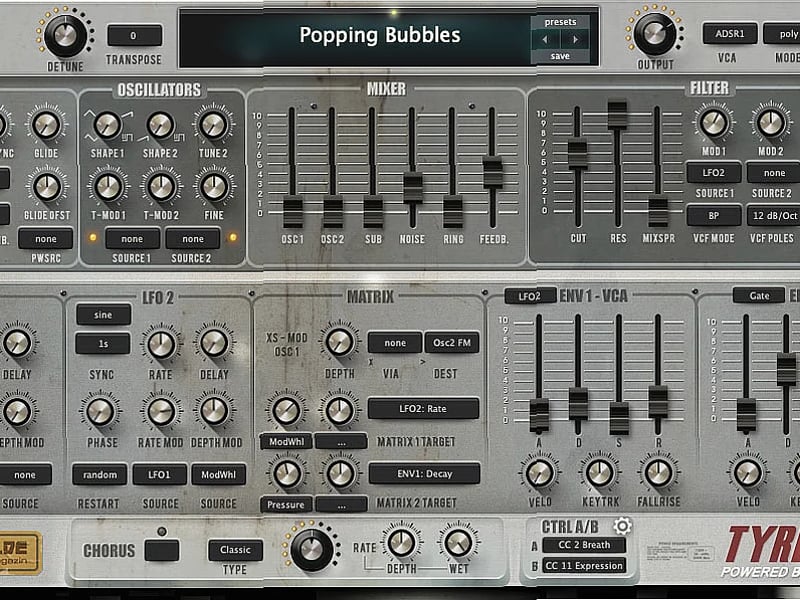
It’s a virtual analogue synth with a familiar architecture, built from ideas for a hardware instrument that was never made. You get everything on one screen: two oscillators, a mixer, filters, modulation, and effects. The workflow is built to keep you moving quickly, with no panel switching or menu diving to slow you down.
Core Technology: Virtual Analogue with a Classic Flow
At its heart, this is a virtual analogue synthesizer built around a classic signal path. The sound generation starts with two oscillators and a noise generator, runs through a mixer with drive, into a filter, and out through amplifiers and effects. The “virtual” part means it models the behavior and sometimes the imperfections of analogue hardware inside your computer. The “classic architecture” means if you’ve used synths like the Juno-106 or Prophet-5, the signal flow will feel immediately familiar. The entire instrument is presented on a single, resizable interface, which is the key to its speed—every parameter is a knob or switch away.
Feature Breakdown
Oscillators, Noise, and Ring Modulation
You start with 2 oscillators and a noise generator. These feed into a ring modulator for metallic, bell-like, or dissonant sounds. The audio source mixer includes authentic overdrive and filter feedback, letting you add grit and character before the signal even hits the filter.
The Twin Filter
The filter is a twin filter related to an early model of u-he’s Diva. This relationship suggests a focus on character and musicality. You can use it for everything from smooth sweeps to resonant peaks.
Modulation System
Modulation comes from 2 LFOs with 8 waveforms each, which can sync to your host tempo. There are analogue-type ADSR envelopes that can be looped or triggered by the LFOs for more complex, evolving modulations. A small modulation matrix allows you to route these sources, with the added ability to modulate the depth of one modulation with a second source.
Unison and Voices
The Unison mode stacks up to 8 voices per note, thickening the sound instantly. This is useful for creating wide pads, brassy leads, or anything that needs more sonic weight.
Chorus Effect
A chorus effect with 3 modes sits at the end of the chain. It’s a simple but effective way to add width, depth, and that classic ‘80s sheen to your patches.
Hardware Integration and Interface
The plugin supports MIDI learn and unlearn, so you can map knobs on your hardware controller directly to any parameter on the interface. The UI is resizable from 50% to 200% and is skinnable, letting you adjust it for your screen or preference.
Factory Preset Library
Over 580 factory presets are included. This gives you a huge starting point for sounds, from basses and leads to pads and effects, and demonstrates the range of the synth.
Technical Specifications
This is a cross-platform plugin available in VST, VST3, Audio Units (AU), AAX, and CLAP formats. It runs on macOS, Windows, and Linux. This broad compatibility means you can likely drop it into your digital audio workstation, regardless of your setup.
Who Is This For?
This fits a few clear scenarios. It’s for music producers who want an analogue-type synthesizer in their DAW without the cost or space of hardware. The single-screen layout is great for sound designers or composers who need to tweak sounds quickly without digging through menus. It’s also useful for beginners learning synthesis, as the entire signal chain is visible and immediate. If you work across different computers or operating systems, the wide plugin format and OS support make it a reliable, go-to instrument.
Limitations
As a freeware product, it doesn’t have the vast modulation or sequencing capabilities of some premium modern synths. The architecture, while classic, is relatively fixed compared to modular or semi-modular soft synths. The filter, while related to Diva, is an earlier model and won’t have the same depth of emulation options as u-he’s flagship products. There’s no built-in arpeggiator or sequencer mentioned.
Final Verdict
If you want a no-fuss, classic virtual analogue synth that loads fast and puts all its parameters in front of you, the Tyrell Nexus is a solid choice. You get a professional sound engine, a huge preset library, and excellent cross-platform compatibility for free. It solves the problem of menu diving and gives you genuine analogue-style synthesis in the box. The catch is its more traditional architecture—it won’t do wild modular patching or complex sequencing. But for bread-and-butter synth sounds and fast, fun tweaking, it’s absolutely worth the download. For those seeking this specific tool, a u-he / amazona.de free download is available from various sources online.
We’ve selected a few plugins that might interest you in the Synthesizer category.
Most of them work in popular VST2/VST3 hosts such as FL Studio, Ableton Live, Cubase, Studio One, and REAPER.

 Popular
 Categories


