A M Converter free download
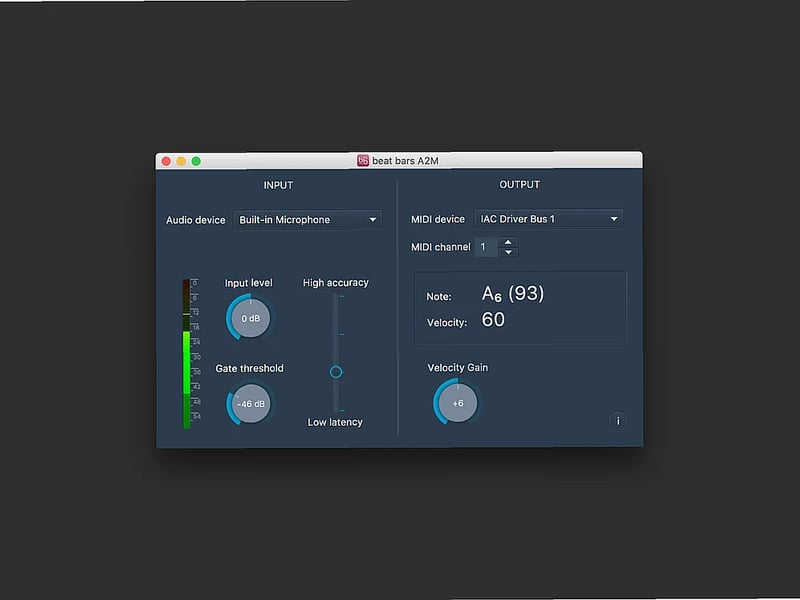
If you’re playing a guitar or another physical instrument and want to control virtual synths or samplers without a MIDI keyboard, A M Converter handles that bridge in real-time. It’s a free download that turns the audio from your instrument into MIDI data on the fly.
Key Takeaway
A M Converter is a standalone application that converts monophonic audio input into MIDI notes. You plug in your guitar or mic up an analogue instrument, and it sends MIDI out to other software or hardware. It’s built for a specific, straightforward job: letting you play MIDI instruments with the instrument you already have.
Core Technology: Real-time Audio to MIDI
The central function is real-time Audio to MIDI conversion. You connect an instrument—like a guitar via line input or an analogue instrument via microphone—to your computer’s audio interface. The software listens to the pitch of that incoming audio signal and instantly generates corresponding MIDI note messages. This MIDI data is then sent to other applications or devices on your system.
Feature Breakdown
Real-time Audio to MIDI Conversion
This is the primary feature. It analyzes the audio input and outputs MIDI note data without perceptible delay, allowing for live performance.
Connectivity Options
You can connect a guitar directly to your audio interface’s line input. Alternatively, you can connect an analogue instrument via a microphone. The software uses your built-in or external audio interface to receive this signal.
Third-Party & Virtual Instrument Support
The generated MIDI output works with third-party virtual instruments and virtual plug-in instruments. It also works with physical MIDI instruments, meaning you can use it to control hardware synths or sound modules that accept MIDI input.
Technical Specifications
A M Converter is a Standalone Application. It runs on both macOS and Windows. You’ll need Windows 8 (64-bit) or later, or MacOS 10.11 (El Capitan) or later. A minimum of 4GB RAM is required, with 8GB recommended. A built-in or external audio interface is required. A significant technical note: only the first default audio-in channel of your audio interface is supported for input.
Who Is This For
This fits guitarists who want to layer synth pads or bass lines underneath their playing without switching to a keyboard. It’s also useful for wind or brass players who have analogue instruments and want to experiment with controlling virtual instrument libraries directly from their horn or flute. If your workflow involves playing a physical instrument first and you want that performance to drive other sounds, this addresses that need.
Limitations
There are some important constraints to know. It has no polyphony, meaning it can only convert one note at a time. It offers no pitch bending capability. As noted, only the first default audio-in channel of your audio interface is supported, so multi-input setups won’t work. Finally, it does not have any built-in samples; it’s purely a conversion utility, not a sound source.
Final Verdict
Grab this free download if you specifically need to turn a monophonic instrument’s audio into MIDI in real-time. You get a straightforward bridge between your guitar or mic’d instrument and the world of MIDI. The catch is the monophonic limitation and the single audio channel support—it’s for simple, one-note-at-a-time conversion. If that matches your need to control a soft synth from your guitar, it’s a practical tool to have.
We’ve selected a few plugins that might interest you in the Utility category.
Most of them work in popular VST2/VST3 hosts such as FL Studio, Ableton Live, Cubase, Studio One, and REAPER.

 Popular
 Categories


